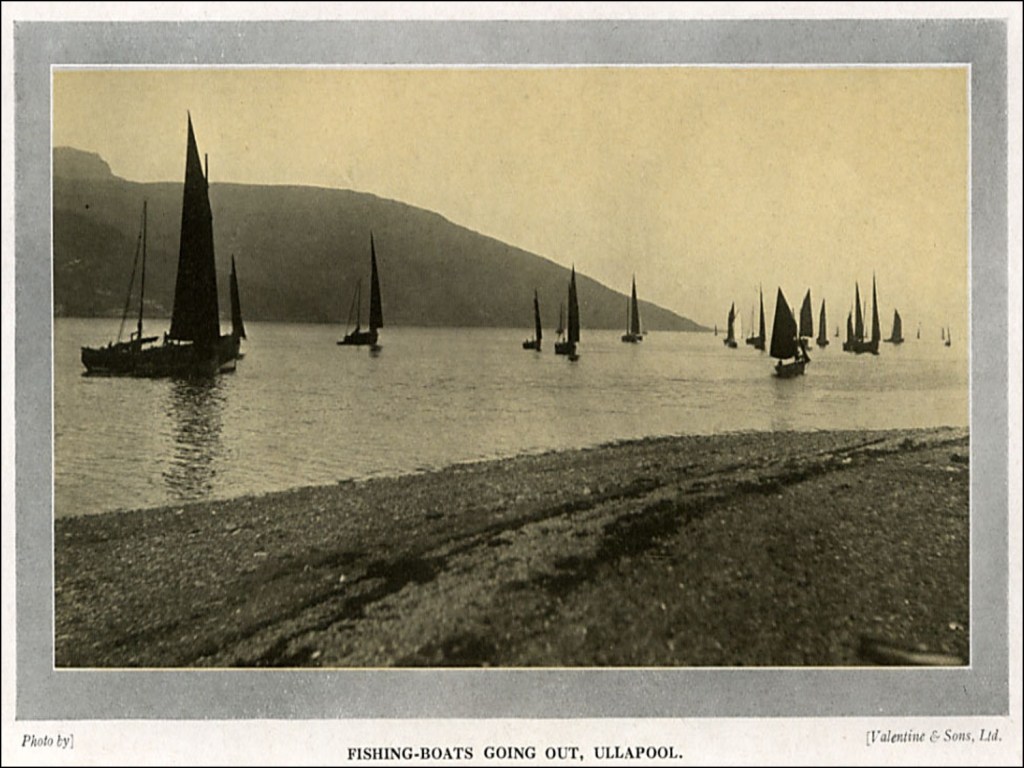
Loch Broom Sailing Club was established in the late 1950s when a keen spirit of competition developed amongst the local working sailing boats in Ullapool.
The founding members were Alec Ross, Dr Whitley and a committee of enthusiastic sailors: Bill Sloan (manager of the Caledonian), and Duncan Duff (joiner); James Macintyrev (haberdashery shop) was the secretary. Early meetings were chaired by Lord Cameron and held in Danny Gordon’s fish hut on the pier.
The club fleet at that time comprised up to eight Bhatas (15 to 17 ft), essentially one design and raced without handicap. The skippers made adjustments to hull and rig to gain that essential edge.
A turning point in the Club was when in the early seventies a grant was secured from the Scottish Sports Council to build the Clubhouse in its current location at the wee pier. With this came the need to formally develop a constitution and appoint office-bearing posts of Commodore, Vice-commodore, Treasurer, and Secretary. Tuesday nights became Club night and darts a hotly contested sport along with the usual banter and chat.
This also signalled a change in the Club fleet. A number of skippers had begun to acquire larger cruising yachts and had turned their attention and enthusiasm towards their upkeep and sailing. Other skippers responded and moved up to Dragons (of which there were three at one time), along with Flying Fifteens and a wide selection of other cruising yachts, including spells of up to three Nicholson 32’s and two Contessa 32’s.
The Bhatas faded away and their enthusiastic crews moved to other boats or other pastimes. Perhaps the only remaining true original is the Mairi, which lies outside Roy Osborne’s house. It was from the hull of the Mairi that the template for the Wee Hector was culled, so the spirit and tradition lives on.
Parallel to weekend, round-the-buoys racing, a separate cruiser racing class began to emerge.
Cruising waters were extended to St Kilda, Orkney, Shetland, Ireland, Norway and, Faeroese waters and, more recently, Sweden, Finland, Denmark, Poland, Iceland, and even America, Canada and Greenland.
Weekend and distant cruising thus became an established feature whilst the racing edge was whetted through the, alternate weekend, round the buoys races in a mixed fleet of (handicapped) boats. Happily, this is a pattern which survives to this day.
 Loch Broom Sailing Club